



Why is no one asking billionaires difficult questions?
The month opened with our Chief Executive Will Snell asking why billionaires so rarely face a serious challenge to their wealth. His starting point was BBC Three’s Are Billionaires Bad?, in which comedian Shabaz Ali puts the case against extreme wealth to philanthropist John Caudwell, only to be waved away with the unevidenced claim that rich people are able to influence politicians simply because they have “good ideas”. Will argues that critics of inequality keep losing these exchanges not because the evidence is thin, but because it’s rarely marshalled, while a sympathetic media, deep lobbying firepower and the enduring myth of meritocracy all tilt the playing field toward defenders of the status quo.
Yet the evidence, he writes, increasingly shows that inequality is actively harmful, not just unfair. Researchers have likened inequality to cholesterol: the kind caused by barriers to opportunity is bad for growth, while the kind arising from effort can be good for it, and most inequality in Britain today falls firmly into the first category. Will argues that we need to be precise about which harms flow from the concentration of wealth at the top, which from the gap between rich and poor, and which from the absence of wealth at the bottom, to make the case for the right remedies. The piece also previewed Will’s forthcoming book (more on that below).
Three ways to skin a cat
The following week, Will set out the policy response in three parts: redistribution, predistribution and guardrails, making the case that taxation is only one way to address rising wealth inequality.
On redistribution, Will revisited our arguments from autumn 2025, when we set out how taxing wealth better could make the tax system and our economy as a whole fairer. Will references the case for a wealth tax proposed by campaigners including Gary Stevenson, as well as Gabriel Zucman’s proposal for a global 2% minimum tax on fortunes above $100 million, and a wider menu of reforms to capital gains, inheritance and property taxes. The arguments for taxing wealth better can resonate with those on the right as well as on the left, as Will recently set out for Bright Blue.
But Will also argues that taxation alone won’t fix a system that concentrates wealth at source. ‘Predistribution’ addresses this through measures such as stronger trade unions, worker representation on boards, and revisiting Liam Byrne’s idea of ‘universal basic capital’.
And because we may never agree on the ‘right’ level of inequality, we also need guardrails: strong public services and a generous safety net that, as in the Nordic countries, stop low levels of private wealth from wrecking people’s life chances and outcomes, alongside limits on the political power that concentrated wealth can buy. Drawing on the sociologist Jens Beckert, Will notes that wealth brings six distinct ‘capacities’: security, opportunity, income, bequest, status and power, and that while public services can substitute for the first four, status and power are inherently positional: one person’s gain is another’s loss, which is exactly why guardrails against their concentration matter so much.
Four locked doors
Next, Will turned to why governments keep failing to act with enough ambition to tackle wealth inequality, identifying four barriers that any serious reform has to unlock: vested interests, the assumption that the public won’t wear it, our failure to treat inequality as a strategic risk, and short-termism. Together, these four locked doors represent structural barriers that have stymied the efforts of previous governments to address wealth inequality through more meaningful policy.
We’ll soon see whether the Burnham government is prepared to open these doors. Chancellor John Healey has confirmed the Autumn Budget for 28 October, and while the Prime Minister has previously expressed support for shifting the tax burden from income toward wealth, property and land, no detailed proposals have yet been published. Will’s piece is a timely reminder of just how easily that ambition can be watered down (as we’ve seen in recent days in respect to caps on political donations).
We can’t have fairness without the nation-state
In a provocative opinion piece, Jack Jeffrey argued that “the nation state is the only means through which we can actually have a fairer society”, and that we need to revitalise a ‘politics of national preference’ in which we ask the fundamental political questions about nationhood - most importantly, where are we going, and to whom are we bound?
In the 1980s, under a Thatcher government that cynically embraced nationalist rhetoric, British firms were sold off to foreign owners at a scale unmatched in comparable economies; international ownership of UK listed companies increased from less than 5% in the early 1980s to more than 50% in 2022. As this vassalisation continues (brilliantly outlined in Angus Hanton’s Vassal State, 2024, a book about which we ran a roundtable with the author a few weeks ago), and the post-war decades are forgotten or misremembered, Britain, as a result, is more unstable, angry and unequal because its institutions have been made subordinate.
The Fair Necessities
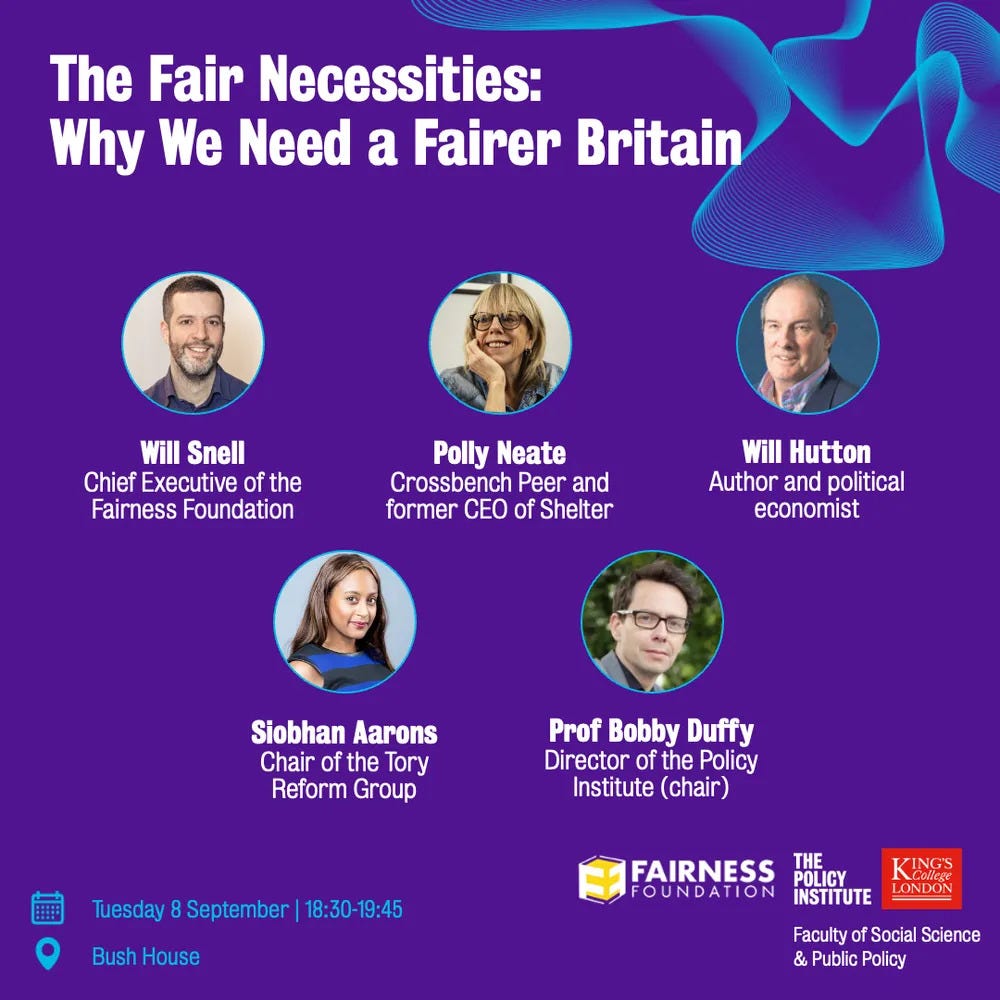
Several of this month’s pieces previewed arguments from Will’s forthcoming book, The Fair Necessities: Why We Need a Fairer Britain and How to Make It Happen, published by Policy Press on 8 September. We’re marking the launch with a panel discussion the same evening at King’s College London’s Bush House, chaired by Professor Bobby Duffy (Policy Institute) and featuring Will alongside crossbench peer and former Shelter chief executive Polly Neate, political economist Will Hutton, and Siobhan Aarons, Chair of the Tory Reform Group. You can register to attend in person or watch via livestream. We’d love to see you there.
Policy Associates
This month also saw the conclusion of our Policy Associate programme with six graduate students from the Blavatnik School of Government at Oxford University. Over the summer, each of our Policy Associate team has been exploring a different aspect of the UK’s uneven distribution of wealth, helping to develop policy solutions and shape ideas for a fairer economy. We’re looking forward to sharing their outputs in the months ahead.
With party conferences around the corner and the Budget less than two months away, September will be a busy month for us. If you are at any of the party conferences this year and would like to connect, don’t hesitate to reach out. And as ever, if you’d like to support our work or collaborate on upcoming projects, please do get in touch.