


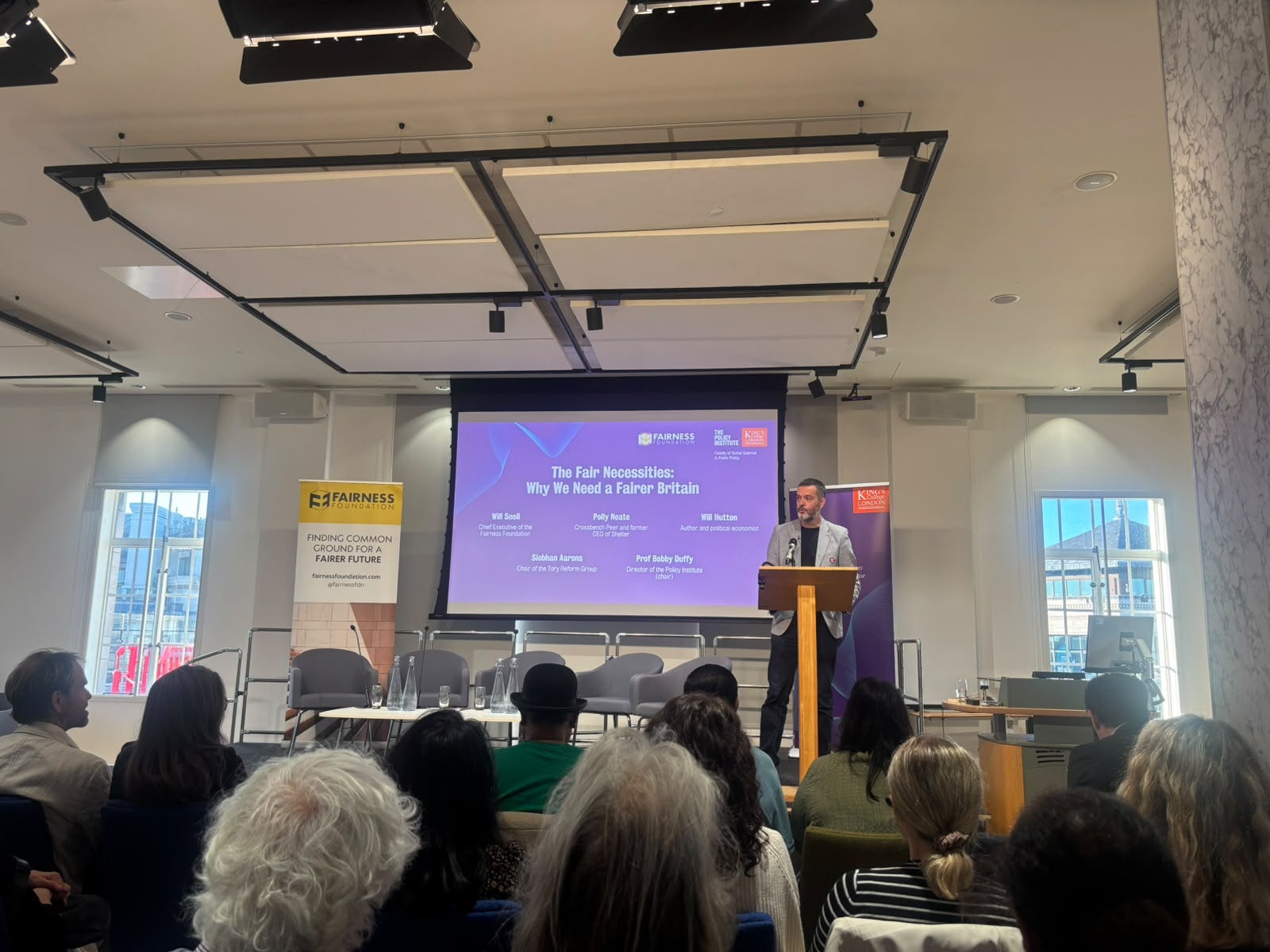
You’ll be sick of hearing that my book, The Fair Necessities, launched last week. I’ve written in recent posts about some of the key arguments (how fairness is definable, necessary and achievable, and how to make it happen), so I won’t rehearse them again here.
The launch event on Tuesday was hosted by the Policy Institute at King’s College London, and I’m very grateful to Bobby Duffy and the team. You can watch a recording below.
Today I want to focus on the discussion at the event itself, which threw up lots of interesting ideas and challenges. I’m deeply grateful to the three panellists at the event - Polly Neate (crossbench peer and former CEO of Shelter), Will Hutton (the economist and journalist) and Siobhan Aarons (chair of the Tory Reform Group) - as well as to the audience for their questions.
I’m going to look at three challenges that came up during the panel discussion that struck me as particularly interesting and important, and respond briefly to each of them, with the benefit of more time and thinking space than I had at the event.
The first came from Polly Neate. Fairness is emotionally powerful, which is exactly what makes it dangerous. “It’s not fair” is the cry of the child: not rational, utterly solipsistic, and built on the assumption that someone else’s gain is your loss. That instinct, she argued, is how men have cast themselves as victims of feminism and how immigrants get blamed for the housing crisis. And she has seen both claims up close. As CEO of Women’s Aid she ran the campaign to end the presumption of child contact in domestic abuse cases, backed by research showing that children were being harmed and killed by court-mandated contact. The fathers’ lobby responded by claiming that they were the victims of unfairness. The campaign took a decade - the Courts and Tribunals Bill will finally address the issue - and in the meantime her house was egged repeatedly and her tyres slashed. What broke the deadlock was not a better statistic but a story: Claire Throssell, whose two sons were murdered by their father during court-ordered contact. “Fighting fire with fire”, as Polly put it.
It’s true that fairness, or its absence, can be used to appeal to all sorts of instincts, and can be a double-edged sword. In my view this is why it’s so important to promote a more positive and unifying version of fairness. Not the grievance-based, zero-sum version that is about the loss that one person suffered because someone else gained - but the better-for-all-of-us version that is based on removing or reducing unearned advantage and ensuring that contribution is rewarded and capabilities enhanced.
The second challenge, from Will Hutton, was that my focus on lobbying as the main barrier to change in my talk was too narrow a diagnosis. He argued that, over the last four decades of so, the idea of a social contract has been deliberately undermined by the neoliberal revolution began in the US that unravelled the Keynesian focus on fairness, public purpose and public intervention to make markets work in favour of untrammelled free markets, and replaced the collectivist “we” with the individualist “I” - an argument that he picked up in his Observer column yesterday. As a result, thirty postwar years of fair settlements and broad growth across the West were followed by forty-five years since of declining growth and declining productivity. And yet, despite the increasingly obvious failure of neoliberal economics to deliver growth and good living standards, the culture war had been won by the individualists.
Will is right - the power of lobbying is only part of the answer, as the book makes clear. The power of individualism makes a fair settlement unachievable in the first place, whereas organised money makes specific reforms undeliverable even where the public clearly supports them. Putting ‘guardrails’ in place like lobbying reforms and caps on political donations is important, because it helps to reduce the conversion of wealth inequality into political inequality, but it is insufficient by itself without a broader shift in our values and culture, a rediscovering of our collective “we” and, as part of that, an abandonment of the collective pretence that we live in a meritocracy when we clearly don’t.
Finally, Siobhan Aarons argued against my assertion that wealth inequality sits underneath all the other barriers to opportunity. Material circumstances matter enormously, because poverty restricts choices around housing, health and education. But human capability cannot be reduced to material circumstances: family, culture, expectations, confidence, discipline, relationships, social capital, individual character and choices all matter. Some of these are affected by wealth, but they aren’t all explained by it. Money can change circumstances without creating capability. She illustrated the point with the image of Ginger Rogers, who did everything that Fred Astaire did, but backwards and in heels. The same outcome tells you nothing about what help or hindrance someone had on the way.
It’s absolutely true that wealth doesn’t provide all of these components of capability, and neither does an absence of wealth deny them. However, while wealth doesn’t explain every advantage, it compounds, transmits and converts - it grows over time, it passes down largely intact through families and generations, and it turns into the political power that undermines the ability of the state to provide everyone with decent life chances and living standards (and the ability of parents to provide the same things for their children). Wealth makes advantage hereditary.
Thanks again to all three panellists and to the audience for the discussion on Tuesday. Please share your thoughts and questions, and if you are or can be in London on 14 October, Oxford on 22 October, York on 4 November or Bristol on 11 November, do sign up for one of the remaining launch events!