


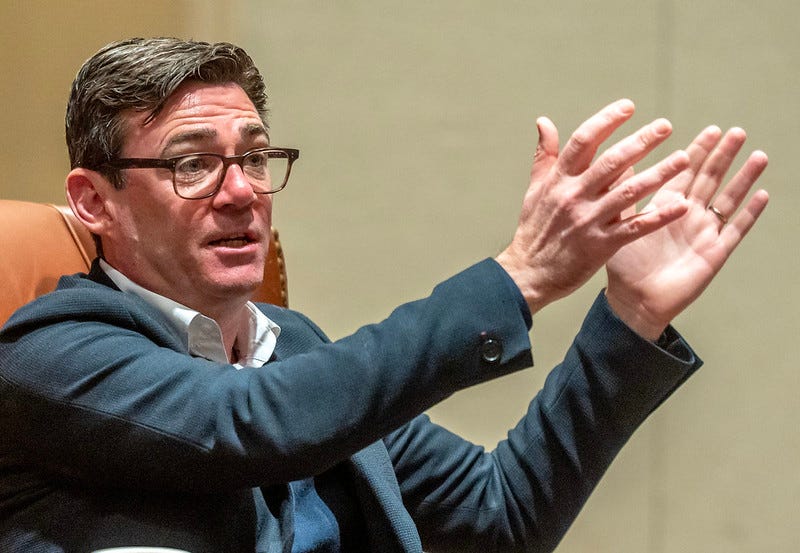
In this interview, our Advocacy Manager Jason Bunting sat down with the Mayor of Greater Manchester, Andy Burnham, to talk about the devolution journey so far, and the reforms that are needed to build a fairer economy across the country. They spoke about the progress made on fiscal devolution in this Parliament, what good growth really means in practice in Greater Manchester, and the political and economic changes required to build on progress to date. The interview links to Jason’s report last December, A Fair Share, which outlined the need for a long-term vision on fiscal powers to local places.
Jason:
In Head North, you describe the tourism levy as the first step on the journey of fiscal devolution. Since its publication, more progress has obviously been made, but it seemed that even the tourism levy was hard won, although it was a reasonably moderate step. Where do you think we are in the fiscal devolution journey, and what do you think it says that even incremental change needs to be fought for?
Mayor Burnham:
It was hard won, but it was won - and it was won when we played back to the government the growth arguments in favour of it. That’s where we started to make a breakthrough. Bear in mind, these are new arguments for the Treasury. They’ve never had a concerted pitch before from people in elected office who’ve got the real ability to implement what we’ve been calling for.
It was when I said to the Chief Secretary of the Treasury that growth has consequences - that if you have a large number of visitors coming in, as we do now, you need later running public transport, you need extra policing, you need street cleaning services, etc. I think they’d not really thought that through - that you need something like this to manage the consequences of growth. If you only try to deal with that through council tax, that’s inherently unfair on the residents - it’s really important to share the cost between visitors and residents.
The growth of cities outside of London confronts the Treasury with new questions, and this was definitely the first big one. Unsurprisingly, they didn’t give in straight away, but to be fair, they did hear the argument and they conceded it.
Jason:
At a recent event, you talked about extractive growth vs good growth, a distinction we talk about a lot at the Fairness Foundation. You said that Manchester has seen too much extractive growth. Can you expand a little bit on what you meant by that, and whether you see more fiscal powers as an antidote to that extraction, or at least as a tool to combat it?
Mayor Burnham:
When I was an MP in the 1990s and 2000s (in pretty much the pre-devolution days), I remember there being a sense that you just have to grab whatever growth you can get. On warehousing and distribution, with the M60 going around the city and then the M6, there’s no shortage of jobs that you can try and bring into those sectors. But those jobs are not long-term, they’re not going to create lots of high-quality training opportunities for young people, and the nature of the employment is often transient. For instance, they wouldn’t be signatories to our good employment charter in Greater Manchester.
So it’s about recognising and being more direct about good growth going forward. It means that organisations which come here do well, hopefully, but then are prepared to recycle some of that upside into our people and our places. I’m being really clear with people that this is what we expect. When I first put forward the idea of the Greater Manchester good employment charter, this was an era when some people were saying, “well, that might deter people from investing here”. It was the sense that you had almost zero power and that in order to get people to come and invest, you had to roll over and just say, “do whatever you like”.
Now, I think it reflects a confidence that we’ve got that says, no, we’re not just saying “anyone is coming in”. We have standards and we’re prepared to stick to our guns about standards. And actually, for people coming to invest in Greater Manchester, we can do more for their brand than they can do for ours. It’s about recognising that the city and region stands for certain things that businesses are often looking for an association with.
In terms of what that might mean from a fiscal point of view, let’s take an example: it used to be called the Apprenticeship Levy and it’s now called the Growth and Skills Levy. One thing we want is the ability to keep all of the levy which is raised in Greater Manchester. At the moment, it goes back to the Treasury if it’s unspent, and there are quite restrictive rules about what it can be spent on. We want a different approach that would allow us to pay for post-16 work experience placements using the levy, or to use it in a highly flexible way to support any work-related activity for young people or for people out of work.
Jason:
I imagine that could be one of the next staging posts on the devolution journey. But do you have any concerns that progress on all of those levers is often incrementally won, through wresting control from Whitehall? We don’t seem to have a long-term vision for it, led centrally. One of the things that we’ve asked is whether we need a commission to look at the tax code and at specific taxes that could be devolved. Do you think that could be an option for a longer-term vision of fiscal devolution?
Mayor Burnham:
I think so, but I wouldn’t start so much with income tax or national insurance. I think the place to start is with quite a significant review of land, property and business taxation, because those are taxes that really land in our world, the ones that we have a close connection with. And one thing that has been a feature of the Greater Manchester Devolution deal is business rates retention. Where we brought in new industry, we’ve been able to keep the upside of that from a business rates point of view, so we have an incentive to keep working to bring in new business and new investment. With some of the first moves on council tax to put in those new bands, I think there is real scope for a more imaginative review of land, business and property taxation linked to local government finance.
I think the risk of devolution actually is the parlous condition of local government, and we need to be really serious about how to repair the foundations. The Greater Manchester Combined Authority is based on 10 councils and if they’re in trouble, then to some extent we’re built on sand, and we have to be careful about that.
I think the time has come for the revaluation of council tax, considering a land value tax to prevent land banking by big entities, and looking at a different form of business taxation that doesn’t overly punish high street physical businesses while under-taxing online operators. That’s where I would look first, because it’s so linked to devolution: land, business and property taxation.
Jason:
Yes, that’s one of the clearest examples of extraction really. Linked to your comments about extractive growth is the question of how to make sure that more sustainable growth reaches all parts of a region. You’ve talked about the Local Industrial Strategy and making sure that the geographic benefits that are accumulated through the proceeds of the industrial strategy reach towns at the lowest possible level. Is that something to which you’ve taken a deliberate approach while you’ve been Mayor?
Mayor Burnham:
Yes, definitely. There are those who make the argument that it’s “towns versus cities”, that you can invest in one or the other and towns are often neglected. We don’t see it that way. We think the fortunes of both are intertwined.
It’s inevitable really that the city has to come first: the city has to be thriving before the towns that are in its orbit can then thrive, and so if you look at Greater Manchester’s development in the last couple of decades, it has been very city centre oriented - although we’ve begun to see Media City as a place of considerable investment, everything around the airport, spreading out down the Oxford Road corridor etc. So it’s begun to spread a bit, but it is still very oriented around the city.
We’ve been quite clear that in the next decade, we have to use the strength of the city to unlock investments in the towns, and the example we often point to is Stockport. Stockport became attractive 7-8 years ago, when it marketed itself as city-centre living at half the cost. It started to use the fact that it’s 10 minutes away from the city centre on the West Coast Mainline, but then said that we can put a modern living experience in, with a high street and night-time economy offer that people in their twenties and thirties want to use. So Stockport was to some degree the forerunner of what we now want to see replicated much more broadly.
We now have a number of mayoral development corporations being brought forward for Stalybridge, Ashton, Middleton and Bolton. Because what we’re trying to say is that the city is strong, with loads of really good jobs there. Now, we can start to lift struggling places, by virtue of their proximity to this vibrant city, and particularly if you then reimagine those places with new living accommodation.
And I do understand the narrative that says, well, the towns always have to wait. But unless your city’s powering ahead, how can the towns power ahead?
One last point is that the vision for the towns has to be linked to an industrial vision. So, one argument to help the towns is by having a city where we say to young people that you can live 15-20 minutes away on public transport with modern city centre style living. But increasingly now, we’ll be building out our vision for industrial clusters linked to our priority sectors. That starts to take higher-end jobs back into the boroughs of the city region. It’s the combination of the two things that is how you lift the towns: better jobs in those areas, combined with proximity to a vibrant city.
It’s a challenging thing to do, but actually, we’re pretty confident that we’ve already got an example in Stockport of having done it.
Jason:
The point that you made about capacity and the strength of the city are obviously interlinked. Do you see a role for central government in relation to the decentralisation of the civil service? Do you think that decentralisation of staff and capacity is something that Whitehall could be more ambitious about?
Mayor Burnham:
I think it could be more ambitious about it. To some degree we’re living in two worlds right now. We’ve got strong, capable, combined authorities across England. And if you look in Northern Ireland, Wales, Scotland, you’ve got devolved authorities there that have strength and capability as well.
And yet we still have a Whitehall system that doesn’t want to let go fully, when I think they should. There should be quite a significant transfer of human resource to the places that are in the business of getting the growth going. I think it’s still the case that the silos of policy come before the places, and it shouldn’t be that way around, but it is, for long-standing cultural and historical reasons.
Growth in a place is one thing - and hopefully it’s good growth - but then you’ve got to match the people to that growth. So that’s the public service reform side of things. Changing the way education, skills, jobs and pensions work, and changing the way the health service intervenes to support people to stay in work - that’s where the agenda should move to.
Whitehall needs to become less controlling of everything and more enabling for that type of change. To me, that points to significant secondment and transfer of staff. Working in a much more place-based team will change people’s policy perspectives. We shouldn’t stay in this two-worlds position much longer. We need to move into a devolved world, and that does imply quite substantial reform of the civil service in Whitehall.
Jason:
That could also be one measure by which you could try and deal with this intractable Whitehall brain and the Treasury orthodoxy that we talk about. It runs so deep within the Whitehall system that you have to do something pretty profound and that means changing the structures and a different way of doing things.
Finally, we often hear about rewiring the state, and it’s been the desire on the part of governments across the last couple of decades to make the state more efficient and capable. Do you think that rewiring the state is actually possible without doing some of the things that you’ve talked about in terms of more ambitious fiscal devolution, and structural reform to Whitehall?
Mayor Burnham:
I’m glad you’ve asked that as the final question because I think there’s something more, a reform that’s more fundamental than anything else we’ve touched on yet, and that’s reform of Westminster. I think Westminster reform will make everything else we’ve talked about more logical. At the moment, we have a Westminster system that doesn’t, and can’t, see all places and people as equal. Half of it is unelected for a start, and it comes mainly from within the M25. Then if you look at the elected house, the whip system - in my experience of being in there - disempowers the elected state and empowers the unelected state. It empowers the Whitehall silos, because they get their way by mandating MPs to rubber stamp what they want.
So, I think you do have to look at Westminster reform as well. I would go for a proportional system and I’d go for an elected second chamber as a Senate of the Nations and Regions. Then you’d have the regional and national agenda set out very clearly, and the heart of the system would be sending a message about the pre-eminence of the nations and regions. It would also put an emphasis on more collaborative working, long-term thinking, and starting to disempower those silos and hold them more to account. I very much believe that these are the enabling reforms that would allow for more civil service reform, fiscal devolution and so on.
I remember my time in Parliament - people work along party lines. If you think of the English regions, if MPs had worked outside the confines of the whip and were able to prioritise their region and fight for it, that would be a different dynamic. As it is, the regions were disempowered by the London-centric Whitehall system. And when you break along party lines, you end up unable to coalesce and convene across a region and unable to champion the region’s interests. So I think that electoral reform is absolutely critical in all of this.
This idea that the Treasury just does its own thing and has its own rules - I’m sorry, but that’s not on anymore. We need to all unite across the regions, nations and across different parties for Westminster reform - that’s my message.
Wow! This is spot on! What a great guy Andy Burnham is.
I live in Australia (dual UK/Australian citizen). We already have many of the things Andy Burnham wants to bring in for the UK. Agreed that electoral reform, to get beyond polarising first-past-the-post, is the essential precondition for everything else to work.
We have proportional representation here, and it has saved us from the more extreme follies of bipolar extremism more than once.
But be warned. It too has its pitfalls. They can be avoided, and seen off, if people are aware of the trap.
The trap is Trumpism.
Here Downunder we are being subjected to an intensive push to fragment our regions and artificially set a so-called "regional Australia" against the supposedly "decadent and degenerate" cities. For "regional Australia", read a coded "white racist ethnocentric isolationist neo-fascist authoritarianism". Plus, very importantly, bogus imported self-proclaimed "Christianity" which of course isn't Christian at all but must urgently be called out as latterday fundamentalist apocalyptic cult.
Our traditional rightwing coalition, between pro-business city social liberals, and the rural regional rump, which used to be called the "Country Party", has split. And right now, the residual centre-right "liberals" have split, and the crooks and extremists have won the day for today, notably by dumping one of Australia's best female politicians. Always, always, keep an eye out for the misogyny.
So that's my view from down here underneath it all.
Andy Burnham seems to be everybody's dream politician. But he and Keir Starmer complement each other. They should not be put in unhealthy, unproductive competition. And for god's sake, watch out for Angela Rayner and Rachel Reeves; the ravening beasts like nothing more than to consume the feminine and feminist for dinner.
Thanks for reading this. If Andy Burnham should ever find himself needing to seek asylum, rest assured, we will welcome him with open arms.
Yeah ... I know ...
An really good interview but why on earth do you want to remove him from his excellent work in Greater Manchester and put him in Westminster where he will have to focus on worldly affairs. The region needs his constructive mind. I do not doubt that he would be good at whatever he puts his mind to but the Westminster media hounds would mark the start of his undoing. They seem to be interested only in the political suicide of the government. You surely cannot seriously believe that putting him back in No10 would change their destructive habits and make them all become Labour supporters?