


Eleven years ago, I became homeless. Again.
I was on maternity leave from my job in education. My baby was just two months old, and my eldest was nine. My husband’s restaurant, his family’s business for 40 years, had never recovered from the recession. People were eating out less. Which is, broadly speaking, bad for restaurants.
Bills became debts. Letters developed that tone. And then the bailiffs started knocking.
We sent sentimental possessions - such as my 1995 unofficial Take That annual - to stay with friends for safekeeping. We lost the once thriving business. And with it, our home above it.
Our home that once hummed with chatter and laughter from downstairs. Our home that always smelled like my favourite food (except on a Saturday night, when it leaned more towards Shiraz). And, for a brief but committed period of time, our home with polka dots on the banister. (A decision made somewhere between pregnancy hormones and a paintbrush.)
I maintained the illusion of calm. Which was quite the achievement, considering my brain had started running a nightly reel of us sleeping in a tent in the restaurant car park. To be clear, this was not the plan. Besides, the car park had a strict short-stay policy.
Between the nightmares, breastfeeding, and my Oscar-worthy impersonation of Ross Gellar’s “I’m fine”, I was exhausted. I felt like I’d failed. Which is a bold conclusion to reach when the economy has just taken your home.
In a moment of déjà vu, I found myself calling the local authority again, asking to be put on the housing waiting list. This time, I was invited to complete a homelessness application. Housing policy’s version of getting a foot on the property ladder.
There is something slightly surreal about applying for your own homelessness. I took the completed form to the housing office, along with three months of bank statements. The local authority approved it, and I joined a weekly bidding ritual – hundreds, maybe thousands, of us competing for a small number of houses.
Every Monday, I logged on and placed my three allotted bids. It was like a silent auction. Except instead of bidding on a spa day, I was bidding on a place to live.
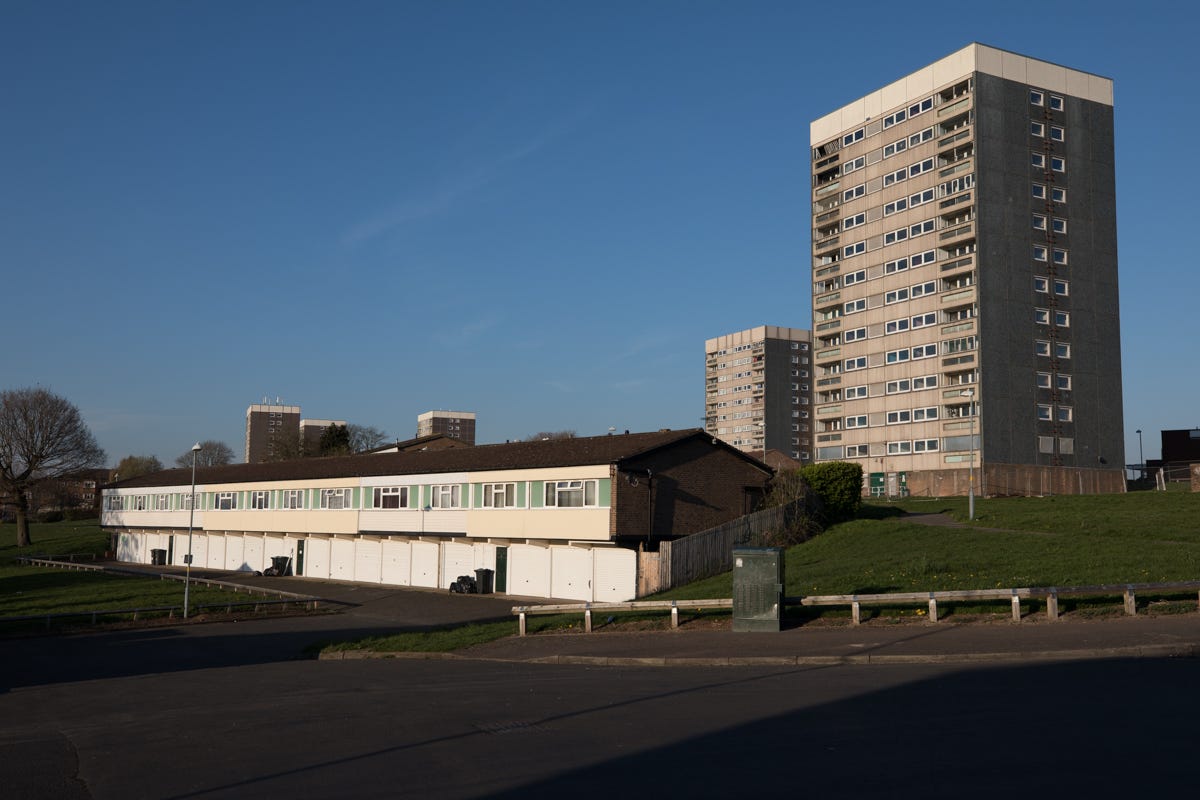
I bid on everything. Old houses. New builds. Edge-of-town properties. Bungalows. Anything that came up. Well, almost anything. I didn’t bid on any properties on the council estate which had been built in the sixties as overspill from Birmingham. Across town, it was known as “the Wastelands”. Professionally, it was labelled “deprived”, largely thanks to its consistently high ranking on the multiple deprivation indices (not a leaderboard anyone is trying to top). I’d even worked there, years earlier. With a role title. And a lanyard. So, I figured I had a pretty good grasp of the place.
Eviction was fast approaching. I was still placing my three weekly bids. Nothing. Then, just before our eviction date, I received an email from the housing office. I had been offered a house - one I hadn’t even bid for! I couldn’t believe my luck.
Until I read where it was. It was on the “Wastelands” estate. If I turned it down, we would – quite rightly – be removed from the housing list. If I accepted it, people would describe us as “disadvantaged”, “rough”, “vulnerable”, or my personal favourite, “hard to reach.”
I was homeless. And I still found a way to be selective. That is how powerful stigma is. And how convincing a single story of place can be.
I had 24 hours to choose between stigma and shelter. Without seeing the house, I chose shelter. And what I found there changed everything.
We met our housing officer at the property. She handed us the keys, a starter tenancy agreement, a rent payment schedule, and a voucher for magnolia paint (paint policy favoured magnolia), then left us to it. My husband and I exchanged a moment of surprise… At how quiet it was. At how safe it felt. A pedestrian walkway. Houses facing each other. A shared green at the centre.
Then we met our neighbours. Chris, the mechanic next door, offered to fix my car. For free. Not because he had spare time. Because he had a skill that he was happy to share. Mo, who sits out front whenever it’s not raining, showed me how to plant when my first attempt resulted in a bed of weeds. Leanne, across the green, finished cooking my kids’ lasagne when my oven broke halfway through making tea and I had nothing else in.
We began to share what we had too. And over time, something changed. Not overnight. Not according to my “getting back on our feet” timeline. But steadily, at the speed of trust.
The story I thought I knew about that place began to fade, and I came to see that this was not a broken place, but a place full of gifts. Skills. Stories. Generosity.
I also learnt that this was a place with a brilliant sense of humour. A few years ago, a campervan blew up on the road just beyond the green (no one was in it, and it wasn’t vandalism as the local media were quick to assume). As about 50 of us gathered to watch the scene unfold, Mo turned to me and said, “this is a better turn out than the jubilee!”.
Crucially, I learnt that it was a place where abundance was weaved into the fabric of community life. Neighbours knew each other’s names. They came outside to watch thunderstorms (and campervan explosions) together. Shared tools. Passed food over fences. Looked after each other’s children, pets, and homes. Held birthday parties out front instead of in back gardens.
And somewhere along the way, it started to feel like home. I’d been there before. Just not as a neighbour. Which, it turns out, matters. As a professional, I had been trained to look for problems. As a neighbour, I learnt to see possibilities.
As a professional, I saw a young woman with four children on the estate and assumed she was “disadvantaged”. As a neighbour, I saw an incredibly capable, resourceful mum who swapped childcare with the people around her whilst she juggled two jobs. Same person. Different lens.
I began to discover that community assets aren’t confined to a place database, and likely don’t have a website, but it is these often invisible assets that hold community together. That discovery changed how I see everything. People. Policy. Places.
It also changed what I do, what I value, and how I see the world. Now, I work alongside organisations, helping them work with communities like mine. Not to fix them. But to build with them. To be good neighbours. The way my neighbours showed me.
And, perhaps most importantly, to recognise that we are the people we are talking about when we talk about community.
Policy gave me a house. My neighbours made it a home. And I still live here today. On purpose.
This piece was written by Charlie Chan, Director of United Communities, and is a follow-up to her earlier piece for us, Policy is personal. It was sparked by a conversation with Will Snell, CEO of the Fairness Foundation, at the Anthropy National Gathering 2026. Charlie was able to be at Anthropy through the generosity of UK Acumen Academy and United Learning.
Devastating article - because it demonstrates all too well the labels that (often well meaning) middle class professionals put on other people and places. This story should be spread widely amongst doctors, social workers and teachers.
'Policy makes houses' ... where, then, is the connexion to be made between community, extolled here, and policy, which involves politics, parties, wet Monday evening meetings, partisanship and, dread word, bureaucracy. Because assembling the resources to build new housing, or just administer the existing stock requires an apparatus, a local state. To operate it, you need councillors, people willing to give their time and energy to a usually fruitless project - winning votes for complex policy.
What happened last Thursday was a near universal rejection of 'policy' in this sense. People voted out councillors without consideration of their performance and, often, very little regard for their policies. The irrationality at the base of local politics was exposed. National party labels alone signified. Councils trying to build and sometimes succeeding were dashed into the slough of 'no overall control'. Councillors making decent and fair housing allocation policies work were summarily rejected.
You might say 'the community spoke', or at least that minority community that bothers to vote in council elections. And what di it say: don't bother us with policy.