



This month, we deepened our focus on the structural inequalities shaping people’s lives. Across our work, we explored how Britain’s economic model continues to entrench unfairness, and considered how policymakers can help to set out a clearer path towards a fairer future.
On 19 March we launched Escaping the State We’re In, a major new report by Will Hutton, Chair of our Advisory Board. It revisits, and radically updates, the arguments that he first made thirty years ago in The State We’re In, setting out how Britain can rebuild an economy capable of delivering prosperity, fairness and long‑term investment. In the process, Will argues for a new model of capitalism that can deliver economic and social good outcomes, based on the unifying value of fairness.
In the report, Will argues that Britain’s economic malaise is the result of decades of underinvestment, policy failure and a political system that has failed to reform. The consequences are now visible in stagnant living standards, declining public health, and a business environment in which too many promising firms are sold abroad or never scale at all.
The report lands at a moment when debates about Britain’s economic model are intensifying, and then the country needs a fundamental rethink of its political economy.
Across think tanks, business groups and even parts of government, there is a growing recognition that the UK’s low‑investment, low‑productivity equilibrium is unsustainable, leaving the country more exposed, more unequal and less capable. It also connects directly to our wider programme of work on wealth, extraction and democratic reform.
Our model of capitalism is currently shifting economic activity away from public markets. Instead of backing entrepreneurial businesses that create value, the system has become skewed towards industries that extract wealth. An economy that relies on asset inflation rather than productive investment inevitably concentrates power, undermines trust and produces zero-sum outcomes.


The report argues that Britain can still become a fairer, stronger and more confident country, but only if it ‘grips the reins’ of capitalism more firmly by mobilising investment, disciplining extraction, rebuilding state capacity and aligning growth with the common good.
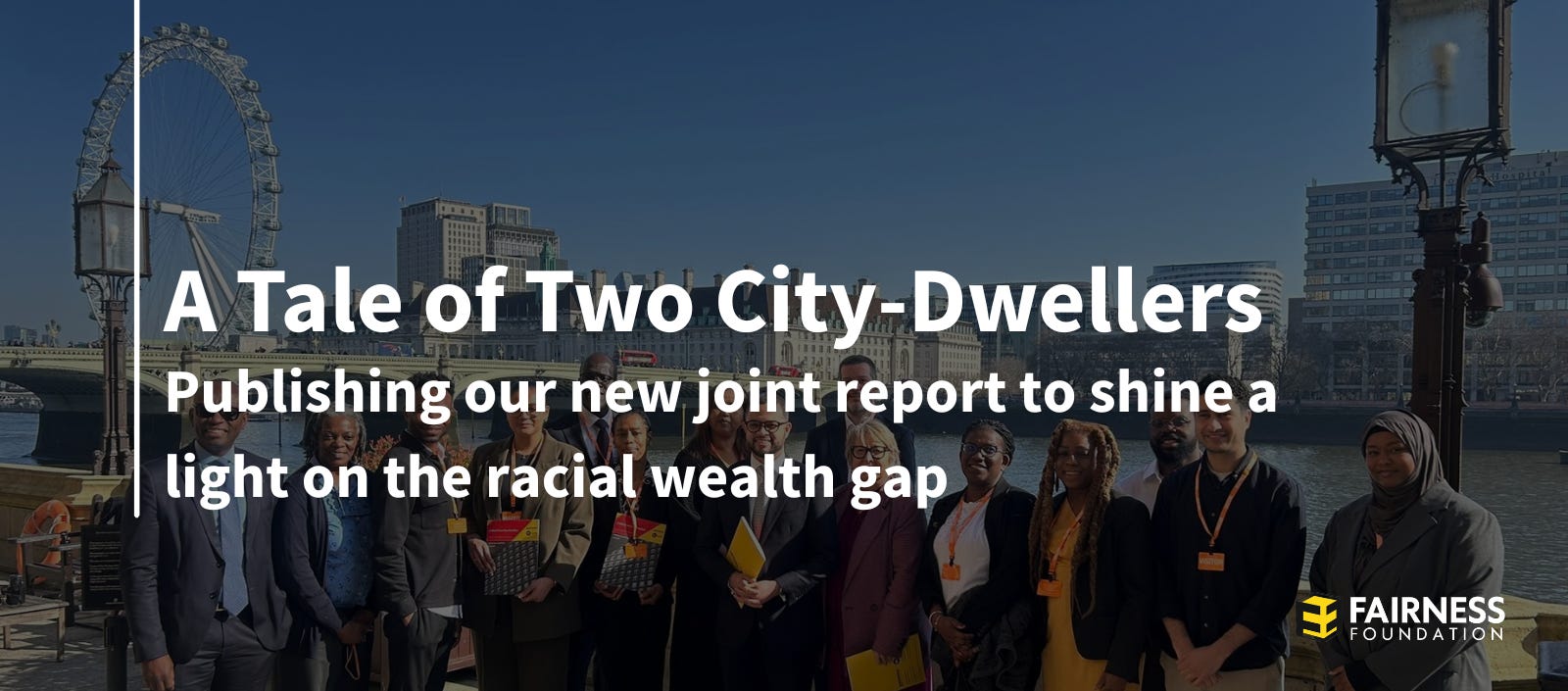
Earlier in the month we published A Tale of Two City‑Dwellers, a joint report with the Black Equity Organisation that examines the racial wealth gap. It combines facts and figures on this pernicious gap with two detailed case studies to bring the evidence to life.
In the report, “Josh”, a White British charity worker, and “Anthony”, a Black Caribbean railway shunter are both 30, live in London, and earn similar salaries, but their life chances diverge sharply because of unequal access to family wealth. The case studies illustrate how wealth, or the lack of it, compounds across education, work, housing and mental wellbeing. They also show how racial inequality and wealth inequality intersect, creating a feedback loop that reinforces disadvantage over time.
The report reveals how wealth inequality now shapes life chances more decisively than income, exacerbating a range of racial inequalities which are the product of both historical discrimination and contemporary policy failures.
The report draws on other research, such as The Runnymede Trust’s Colour of Money report from 2020, which analysed ONS data to show that for every £1 owned by White British households, Black African and Bangladeshi households hold only 10p. It also includes contributions on ethnicity pay gap reporting, timely given the recent Cabinet Office consultation on the issue, with the government’s positive response published last week.
We’re grateful to the cross-party MPs who joined us in Westminster to launch the report at a breakfast roundtable this month (and particularly to our host Adam Jogee MP for sponsoring the event). As Britain prepares for major debates on tax, housing and economic reform, this work reminds us that racial inequality remains central to the conversation.
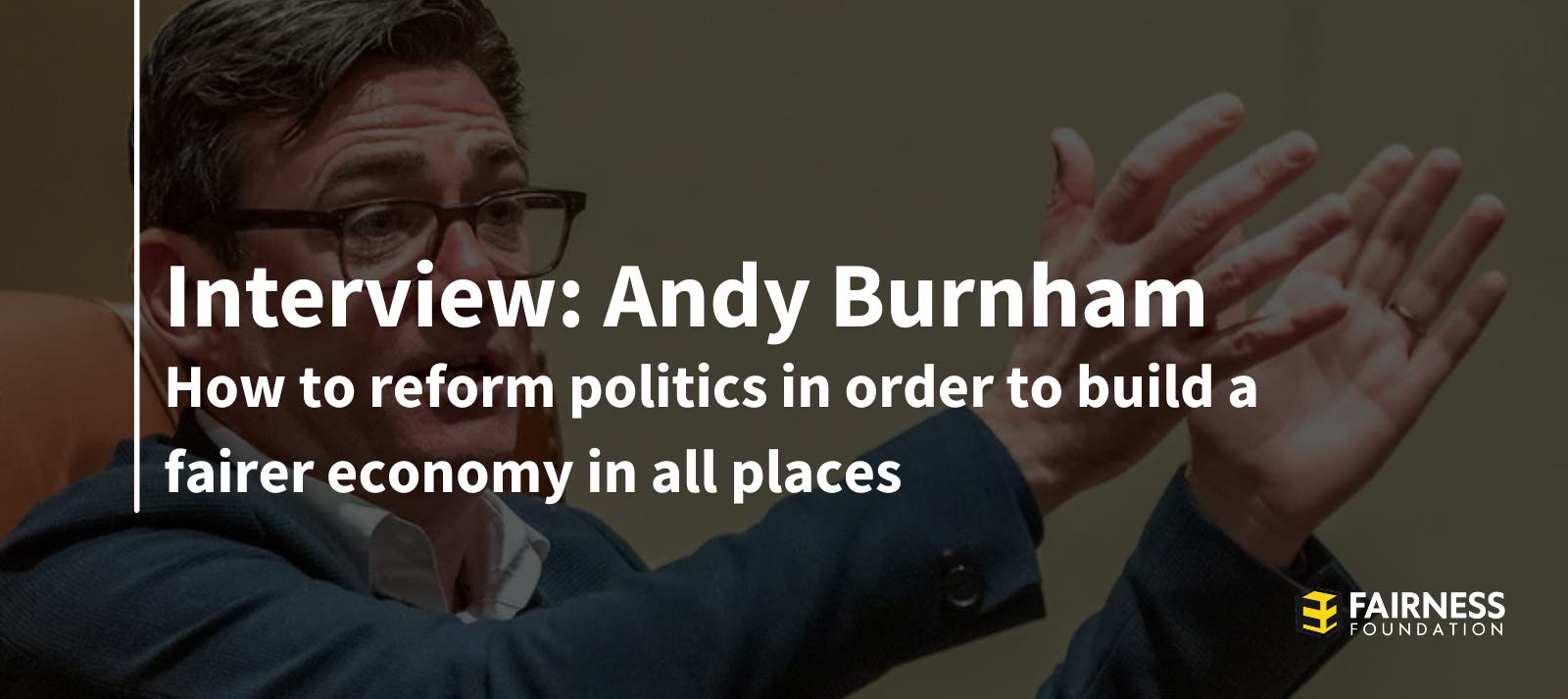
We also published a long‑form interview with Andy Burnham, Mayor of Greater Manchester. In a wide‑ranging conversation with our Advocacy Manager, Jason Bunting, the Mayor discussed how devolution can help unlock fair growth, and how political reform is needed to drive a fairer economy across the country.
He drew a sharp distinction between growth that enriches communities and growth that extracts value without building long‑term prosperity, mirroring our own work on wealth extraction and the need for an economy that rewards innovation, not rent‑seeking. The Mayor also made the case for devolving land, property and business taxation as a way to give places the tools they need to shape their own futures. This aligns closely with our December report A Fair Share, which argued for a long‑term vision for fiscal powers at the local level.
Perhaps most striking was the Mayor’s argument that meaningful devolution would be best unlocked through Westminster reform, including an elected second chamber representing the nations and regions.
Of course, regional inequality remains one of Britain’s most persistent structural problems- and one of the most obvious and pressing examples of unfairness in the economy. The Mayor’s comments helped to connect the dots between fairness, devolution and national renewal, a theme we’ll continue to explore.
Fortunately, the argument for greater fiscal devolution appears to be gaining momentum, as evidenced through the Chancellor’s announcement in her Mais lecture that she will develop a roadmap for future fiscal devolution, including plans to give regional leaders control of a share of some national taxes.
This month we also published a new blog by our Senior Researcher Jack Jeffrey. It explores why Britain’s property tax system is widely acknowledged as unfair, outdated and distortionary, yet has proven so resistant to reform.
As Jack lays out, property taxation is, of course, a political issue which is rooted in the central role that home ownership plays in Britain’s social imagination. For many people, property is not just an asset but a symbol of security, independence and moral worth. Any reform is therefore interpreted not as a system fix but as a personal threat. Yet Britain’s reliance on property wealth has distorted the economy, widened generational divides, and entrenched inequality.
As Lisa Adkins and others have argued, we now live in an “asset economy” in which access to appreciating assets matters more than wages or productivity. This helps explain why even modest reforms, such as revaluing council tax bands, face fierce resistance, despite widespread recognition that the current system is unfair and notwithstanding recent developments such as the introduction of the High Value Council Tax Surcharge.
Those are issues that have been advanced at length by a range of campaigners and organisations, notably the Fairer Share campaign which has built significant momentum for reform and is currently running a petition calling on the Government to replace Council Tax, Stamp Duty and the Bedroom Tax with a Proportional Property Tax.
The politics of property taxation sits at the intersection of several themes we’ve been exploring, such as the rise of wealth over income as the driver of inequality, the difficulty of reforming systems that benefit powerful groups and the need for a new political economy that reduces reliance on asset inflation.
If you’d like to discuss any of this month’s work, collaborate on future projects, or share your reflections, we’d love to hear from you.